

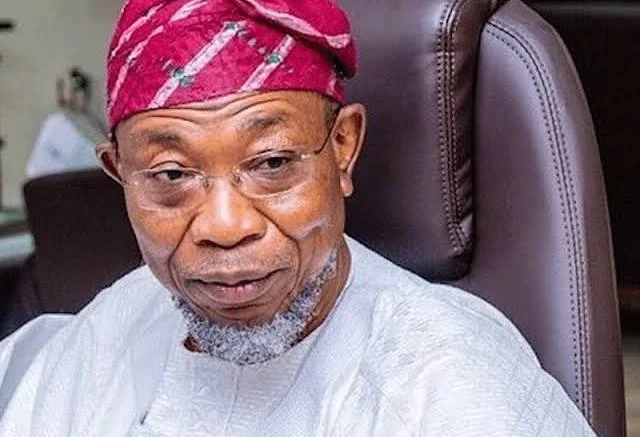
Oluwaseun Abosede, the Organising Secretary of Omoluabi Progressives, a political group aligned with the National Secretary of the African Democratic Congress, Rauf Aregbesola, speaks with BOLA BAMIGBOLA on the perceived political tension between Governor Ademola Adeleke and Aregbesola
Ex-Governor Rauf Aregbesola was, until recently, believed to have a good relationship with the incumbent Osun State Governor, Ademola Adeleke. With the benefit of hindsight, what would you say happened?
Well, Ogbeni never really had issues with anyone—politicians or businessmen. He maintains a cordial relationship with everyone, or at least with anyone willing to associate or work with him, as long as such engagement aligns with pro-people interests. That extends to Governor Ademola Adeleke too. However, they’ve never shared any political common ground since Adeleke left the APC a long time ago.
Of course, Adeleke did benefit from the internal rift between Governor Oyetola and Ogbeni within the APC at the time. The fallout was so severe that Oyetola and his camp completely sidelined Ogbeni and his loyalists from the party’s political structure. As a result, Ogbeni’s followers either adopted a “sit down and look” posture or defected to the PDP.
In the end, this situation helped clear the path for Adeleke’s victory at the polls. Beyond that perceived camaraderie, there was never any real alliance between them. That was in 2022.
Did Aregbesola actually threaten to oust Adeleke in the 2026 poll?
A few days ago—specifically on Sunday, July 13th, 2025—members of the Omoluabi Progressives in Osun State, alongside ADC members and well-wishers, trooped out in their thousands to welcome Ogbeni back home following his appointment as the Interim National Secretary of the ADC.
In his speech, as expected, he made a promise to do everything within his capacity to “take back Osun in 2026.” And if I may add, that’s not a threat—it’s exactly what we intend to do, by the grace of God and through deliberate, grassroots engagement with the people.
This declaration immediately sent shockwaves through the Adeleke political dynasty, throwing them into panic. Governor Adeleke himself betrayed this panic through the series of unfounded and negative attacks he launched against Ogbeni.
Would you have expected Adeleke to take Aregbesola’s remarks at the Sunday rally as mere political talk?
Whether Governor Ademola Adeleke took what was said as mere political talk or not depends entirely on him and how he chooses to interpret it. But the truth is, he is helpless in the face of what is coming.
For a long time, his dynasty-style administration has quietly hoped to inherit Ogbeni’s political support base—because wherever that base swings, it almost guarantees victory for that camp. So, as Adeleke began to think seriously about his re-election bid in 2026, he was naturally hoping to win over Rauf’s loyalists. But the moment the ADC entered the picture and we boldly came out to declare our intentions, the honeymoon was over. That’s when the panic set in, and they began to shiver.
But the two men reportedly worked together to oust the immediate past governor, Adegboyega Oyetola. Is that not correct?
I’ve already explained how it only appeared as though the two of them worked together—which wasn’t the case at all.
Throughout the entire electioneering period, you’ll recall that Ogbeni never even set foot in Osun. There were two main reasons for that. First, he was serving as a Minister at the time and was deeply engaged in addressing the serious internal security challenges facing the country, so there really wasn’t time.
Secondly—and more importantly—the Oyetola-led system had completely shut him out of the political process. It got so bad that non-state actors even attacked Ogbeni on February 14, 2022, around the Orisunbare Market axis. That incident practically forced him to stay away from Osun throughout the election period.
So, no—it is not accurate to say he worked with anyone to remove Alhaji Oyetola from office.
What defence do you have for some of the issues raised against Aregbesola by Adeleke in his statement?
It is unfortunate that the current administration of Governor Ademola Adeleke, instead of focusing on governance and delivering on its promises, has become trapped in political confusion and a blame game devoid of direction.
The debts incurred under the administration of Ogbeni Rauf Aregbesola were not the product of recklessness or indulgence. They were strategic investments—channelled into initiatives like the Consolidation Fund (the first of its kind in Nigeria, long before the Federal Government adopted a similar model as the Sovereign Wealth Fund), human capital development, the most successful Rural Access Mobility Programme, social protection schemes, security architecture, youth empowerment, the Schools Calisthenics initiative, and the internationally acclaimed School Feeding Programme. These were complemented by urban renewal efforts and monumental infrastructure projects—world-class schools, durable road networks, and upgraded healthcare facilities—assets that, today, would cost exponentially more to construct due to inflation and the harsh economic policies currently in place.
As for the much-talked-about modulated salary regime—often mischaracterised by critics as “half salary”—it was never a premeditated policy, but rather a response to a nationwide fiscal crisis. It arose when the Federal Government consistently failed to disburse funds to states as expected. The situation became so dire that many states could no longer meet their wage obligations, and Osun was not exempt.
At that point, some advisers suggested downsising the workforce to stay afloat. But Ogbeni Aregbesola flatly rejected the idea. He refused to take away people’s livelihoods in a temporary crisis he believed would eventually pass. Instead, a transparent and inclusive solution was pursued. A joint committee—comprising labour leaders, civil society organisations, and chaired by the then Chief of Staff (who later became Governor himself)—was formed. That committee recommended the modulated salary system as a temporary measure to avoid mass layoffs.
Under that system, junior civil servants (Levels 1–7), who formed the majority, continued to receive full salaries. The partial salary arrangement only applied to senior civil servants and political office holders. For emphasis, political office holders—including commissioners, aides, and others—also bore the brunt of this sacrifice.
Ogbeni himself would have been affected, but it is on record that he never collected a salary throughout his tenure as governor. To this day, unlike many former governors in Nigeria, he does not receive any pension.
That is the real story behind the so-called “half salary” narrative. Let’s also not forget the broader national context. Over 20 states across Nigeria experienced the same salary crisis during that period. These were the years when oil pipelines were frequently sabotaged by Niger Delta militants, and as much as 400,000 barrels of crude oil were reportedly being stolen daily. This crippled oil revenues, sent the economy into a tailspin, and drastically reduced allocations to federal, state, and local governments. For anyone to single out Ogbeni for scapegoating is, frankly, mischievous and misleading.
It took the intervention of then-President Muhammadu Buhari for states to receive bailouts and begin to recover. From the very first day of his administration—sworn in on November 27, 2010—Ogbeni prioritised the rights and welfare of civil servants. Within weeks, he cleared the salary arrears left behind by his predecessor, paid a 13th-month bonus in the second week of December 2010, and ensured December salaries were paid before Christmas.
He also reformed leave allowance payments. What used to be treated as a privilege became a right, and workers were given the choice to have their leave bonuses paid either based on their date of birth or employment—automated and transparent, eliminating the arbitrary and unfair methods of the past.
Neither Governor Gboyega Oyetola nor Governor Ademola Adeleke continued this practice. That reform has since been abandoned by both administrations. We also make bold to state that full salaries had resumed several months before Ogbeni left office. In addition, six months’ worth of the withheld salaries had already been paid to the affected senior officials and political appointees. Unfortunately, it was the Oyetola administration that chose to punish those workers further by refusing to pay the remaining backlog—even after the state’s finances had stabilised. That is not a matter of opinion; it is a matter of public record.
But in your reaction, your group also attacked Governor Adeleke, saying he was looking for acceptance. From who?
We didn’t attack anyone. We simply stated the facts. It’s already in the public domain that Governor Ademola Adeleke was considering jumping ship—leaving the very party that gave him a mandate—to join the APC. One must wonder: what kind of fear has Ogbeni instilled in them for such a desperate marriage of convenience to even be considered?
We merely pointed out the obvious—that both the APC and PDP have lost touch with the people and have become political weaklings. If Governor Adeleke thinks the APC can shield him from electoral defeat in 2026, then both he and the APC will lose—together. It’s as simple as that.
As of now, Governor Adeleke has not formally defected to the APC. He hasn’t publicly declared his intention or officially registered with the party. But sources within both camps confirm that a “pregnancy” is in the works—one conceived in mischief and confusion. It is unfortunate and, frankly, shameful that a sitting governor, who controls the entire political machinery—both elected and appointed—finds himself in such a state of political disorientation. He is now courting the APC, a party that came to power on a wave of hope and promise, only to deliver pain, hardship, and national disillusionment.
From skyrocketing inflation to deepening insecurity, from failed power reforms to deteriorating infrastructure, the APC government has proven to be high on propaganda and woefully low on performance. Today, millions of Nigerians are battling poverty, hunger, and despair—yet under President Bola Ahmed Tinubu, the country continues to lack purposeful, people-centered leadership. The time has come for Nigerians to reject deceit and embrace genuine change—the kind of change the ADC is offering.
With the challenge from Adeleke, how prepared is your party for the 2026 governorship poll?
First of all, Ogbeni’s popularity is such that no amount of disparagement, scandal-mongering, or political mischief can diminish it. His legacy is rooted in a passionate commitment to human development, and that has earned him deep respect across Osun. The ADC is building on that strong foundation. Just like in 2014, when Ogbeni mobilised massive rural support and secured victory with over 100,000 votes, we are already on track to replicate—and even surpass—that feat.